
The 2026 Nobel Prize in Chemistry Explained: Why Life Picks One Hand

Spearmint and caraway smell nothing alike. Both smells come from the same molecule, carvone. The atoms are identical, and only their arrangement in space differs, the way your left hand differs from your right. Chemists call the two versions mirror images.(1)
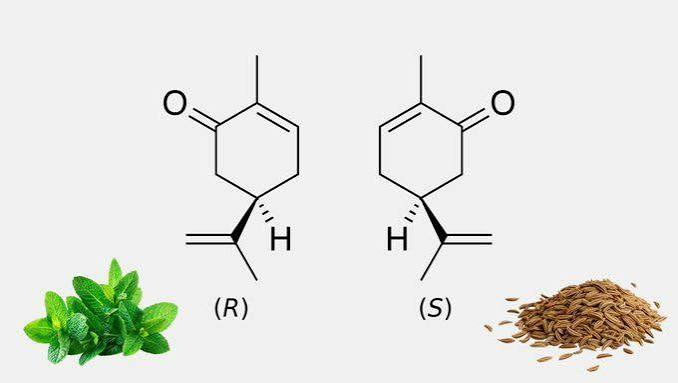
In medicine, the two hands do not always behave the same way.
In 1957, the German company Grünenthal began selling a drug called Contergan.

Pregnant women took it against morning sickness.
Each pill held thalidomide in both hands, half left and half right. Doctors linked the drug to serious birth defects, and it was pulled from sale in late 1961. More than 10,000 children worldwide are thought to have been affected (2).
In 1979, researchers tested each hand on its own in animals.
One hand had the calming effect.
The other hand caused the birth defects (3).

The obvious fix looks simple: sell the calming hand only.
That fix fails inside the body. Within hours, each hand of thalidomide turns into the other (3, 4). A pill made only of the calming hand becomes a half-and-half mix again after the patient swallows it. Choosing the right hand at the factory would not have made the drug safe for pregnant women.
Your body makes the same distinction between mirror images. It builds its proteins from one hand only. In a test tube, chemistry left to itself makes both hands in equal amounts. For more than a century, chemists had no explanation for how nature got from fifty-fifty to one hand only.
On Wednesday 7 October 2026, the Royal Swedish Academy of Sciences gave the Nobel Prize in Chemistry to the two chemists who found the answer: Henri B. Kagan and Kenso Soai (5).

Soai's experiment shows the idea in one number.
In 1995, he put two teams of molecules in a flask, left hands and right hands.
The teams were almost equal: 51 on one side, 49 on the other. Then the reaction started. Every new molecule came out the same hand as the molecule that helped make it, so the bigger team grew faster than the smaller one (6). Round after round, the gap got wider.
In 2003, Soai ran a reaction that ended with one team only (5).
Same atoms, opposite hands
Your nose already knows
Hold your two hands palm to palm. They match.

Now lay one on top of the other, both palms down, and the thumbs point in opposite directions.

Chemists call molecules with this property chiral, from the Greek word for hand (1).
Back to the spearmint and the caraway seeds in your rye bread. Your nose tells the two carvones apart because the smell receptors inside it have a handedness of their own (1).
A molecule of the wrong hand fits the receptor the way a left glove fits a right hand.
Fifty-fifty in the flask, one hand in your cells
Amino acids, the building blocks of proteins, also exist in two mirrored forms.
The proteins in your cells use one of them. The other rarely appears in nature (2). Chemists call this homochirality, from the Greek for "same hand".

When chemists ran reactions able to make both forms, the flask returned equal amounts of each.
That result created two problems.
The first was scientific: if chemistry left alone produces a fifty-fifty mix, something had to tip life toward one side.
The second was commercial. In a medicine, only one mirror image produces the intended effect.
The left-handed version of a drug may have one effect and the right-handed version another.
Kagan, 1986: the output beat the input
Chemists steer a reaction toward one hand with a catalyst, a helper molecule that takes part in the reaction and comes out unchanged.
The working assumption was linear.
A helper that is 50% pure in one hand gives a product about 50% pure in that hand. Double the purity of the helper and you double the purity of the result.
In 1986, Henri Kagan and his team tested that assumption and broke it.
In their reactions, the product came out purer in one hand than the helper they started with. Kagan named this deviation a non-linear effect (7).
Your glove drawer shows the mechanism.
Put 70 right gloves and 30 left gloves in a drawer. Pair every left glove with a right one and set the 30 pairs aside. Forty gloves stay loose, and every one of them is a right glove.
Start: 70 right - 30 left = a 40-point lead for the right hand
After pairing: 40 loose gloves, 40 right, 0 left = 100% right
Catalyst molecules behave in a similar way.
Partners of opposite hands lock together into pairs that do little or no work, and the majority hand stays free to run the reaction. In the systems chemists have studied in detail, the mixed pairs turn out to be the more stable ones (8).
Soai, 1995 to 2003: a reaction that copies itself
The sourdough principle
A baker keeps a piece of yesterday's dough to start today's bread. The product of one batch seeds the next one.
Chemists call a reaction whose product speeds up its own formation autocatalytic.
Kenso Soai built a reaction in which the product molecule guides the formation of more of itself, with the same handedness. That is why the 51-to-49 mixture from the opening did not stay at 51 to 49. Each round of product served as the catalyst for the next round, and the majority hand made more of itself than the minority hand did (6).
The 2003 result, one hand only, matters for a reason the Academy states plainly:
Nobody other than life itself had achieved it before.
Forty years from flask to Stockholm
Count the years. Kagan's first decisive step dates from 1986, and the prize came in 2026. That makes 40 years. Soai's key paper is 31 years old.
The committee also stayed honest about the limits. Somfai told the Associated Press that it is hard to point to one specific drug developed with these methods (7). The prize rewards an explanation of how one hand wins, and the Academy ties its pharmaceutical value to the chemists who design manufacturing reactions..
Run the same test on your CSR strategy
Kagan and Soai answered one question:
How a small imbalance at the start becomes total dominance at the end?
A CSR plan built on proportional thinking assumes that inputs and outcomes move together, one euro of effort for one unit of impact. Chemistry showed in 1986 that this assumption fails. Here is the comparison, level by level.
People
Go back to thalidomide. A bottle of the harmless hand becomes a mixture once a patient swallows it. Purity at the point of production did not guarantee purity at the point of use.
Your codes of conduct carry the same risk. A policy written cleanly at headquarters meets site managers, subcontractors and local incentives, and it changes form. The audit at headquarters checks the policy as written. Your workers experience the policy as applied.
Kagan's result applies to boards as well.
In October 2025, women held 38.2% of non-executive seats and 33.6% of all director seats in the EU's largest listed companies (9). Directive (EU) 2022/2381 set a target of 40% of non-executive seats, or 33% of all director seats, for listed companies by 30 June 2026 (10). Those figures measure the composition of the catalyst.
Kagan proved that composition does not translate into the output in a straight line. No public dataset tracks how far each director shapes the final decision.
Planet
Agriculture shows the gain from picking the right hand.
Metolachlor, a herbicide used on maize, contains mirror-image forms. Agronomists at Syngenta reported in 2002 that the S forms are about ten times more active than the R forms. The old mixed product required 2,000 to 3,000 grams per hectare. The S-enriched version, S-metolachlor, requires 1,200 to 1,900 grams for the same weed control (11).
Low end: 1,200 / 2,000 = 0.60, so 40% less active ingredient
High end: 1,900 / 3,000 = 0.63, so approximately 37% less.
A farmer who switched puts approximately 37 to 40% less active ingredient on each hectare.
Now the complication.
Swiss researchers tracked metolachlor in Lake Baldegg from 1997 to 2001. The chemical fingerprint of the residues shifted to the new S product within a few years. Their data did not show lower total concentrations in the lake, because heavy rain during the spraying seasons made the year-to-year comparison unreliable (12). The dose reduction comes from the manufacturer's own agronomists. The independent lake data confirms the switch. It does not confirm the environmental benefit.
Profit
The classic industrial route to a single-hand molecule makes both hands and separates them afterwards. Run the arithmetic on that route.
Reaction output: 50% right hand + 50% wrong hand
Maximum usable yield: 50%
Per 1 kg sold: at least 1 kg of the wrong hand, unless recycled
You pay for the raw materials, solvents, energy and disposal of a molecule nobody buys.
That waste sits on top of an already heavy load.
Pharmaceutical manufacturing generates approximately 25 to 100 kilograms of waste for every kilogram of active ingredient, a range first set out through the E factor that the chemist Roger Sheldon introduced (13).
Sheldon described one fine-chemical process in which the cost of disposing of its chromium waste approached the sales value of the product itself.
CSR budgets carry the same blind spot.
A sustainability line reported as spend counts the inputs. It says nothing about the share of that spend that produces the intended result, and nothing about the share that ends up as the corporate equivalent of the wrong hand.
Why this chemistry earned the Nobel Prize
For more than a century, chemists knew that life uses one hand and had no chemical mechanism that explained how one hand wins from an almost even start.
Kagan showed that the purity of the output does not have to follow the purity of the input.
Soai showed that a product able to copy itself turns a small lead into total dominance.
The two results give origin-of-life research a working mechanism and give pharmaceutical chemists principles for designing reactions.
Four chemistry prizes, one thread
2023, quantum dots (Bawendi, Brus and Ekimov): the size of a nanoparticle sets its colour.
2024, proteins (Baker, Hassabis and Jumper): computational design of new proteins and prediction of the shape of existing ones, the shape that sets each protein's job.
2025, metal-organic frameworks (Kitagawa, Robson and Yaghi): designed porous structures that trap large quantities of gas, with potential use in capturing greenhouse gases.
2026, mirror-image chemistry (Kagan and Soai): the handedness of a molecule decides what it does in your body and in a maize field.
Look at what links the four. Each prize rewarded a discovery about the way matter is arranged. In a quantum dot, size sets the colour. A protein’s fold decides its job. The pattern of holes in a framework decides which gas it traps. With carvone, the hand decides between mint and caraway. Same atoms, different arrangement, different result.
Now hold a CSRD report next to that list. The European Sustainability Reporting Standards ask mainly for totals, such as gross greenhouse gas emissions in tonnes of CO2 equivalent and the number of employees.
A total works like a kitchen scale.
Think back to the metolachlor case. A farm record shows how many grams of herbicide the farmer sprayed per hectare. It does not show whether the farmer used the old fifty-fifty mix or the product enriched in the active hand.
A CSRD report works the same way. It counts how much a company emits, how many people it employs and how much it spends. It says far less about how those tonnes, people and euros are arranged inside the business.
(1) Russell, G.F. and Hills, J.I., Odor differences between enantiomeric isomers, Science, 1971. https://pubmed.ncbi.nlm.nih.gov/5573954/
(2) CNN, German maker of thalidomide apologizes, 1 September 2012. https://edition.cnn.com/2012/09/01/health/germany-thalidomide-apology
(3) Tokunaga, E., Yamamoto, T., Ito, E. and Shibata, N., Understanding the thalidomide chirality in biological processes, Scientific Reports, 20 November 2018. https://doi.org/10.1038/s41598-018-35457-6
(4) Proceedings of the National Academy of Sciences, Differentiation of antiinflammatory and antitumorigenic properties of stabilized enantiomers of thalidomide analogs, 2015.
(5) Royal Swedish Academy of Sciences, Press release: The Nobel Prize in Chemistry 2026, 7 October 2026. https://www.nobelprize.org/prizes/chemistry/2026/press-release/
(6) Soai, K., Shibata, T., Morioka, H. and Choji, K., Asymmetric autocatalysis and amplification of enantiomeric excess of a chiral molecule, Nature 378, 767, 1995. https://www.doi.org/10.1038/378767A0
(7) Associated Press, via Anchorage Daily News, Nobel Prize in chemistry awarded to Kagan and Soai, 7 October 2026. https://www.adn.com/nation-world/2026/10/07/nobel-prize-in-chemistry-awarded-to-kagan-and-soai-for-untangling-mirror-images-in-molecules/
(8) In situ mass spectrometric and kinetic investigations of Soai's asymmetric autocatalysis, Chemistry: A European Journal, 2020. https://pmc.ncbi.nlm.nih.gov/articles/PMC7756584
(9) European Institute for Gender Equality, Gender balance in decision-making: largest listed companies, data for October 2025, published 2026. https://eige.europa.eu/sites/default/files/documents/202602335_pdf_mh0126044enn_002.pdf
(10) European Parliament and Council, Directive (EU) 2022/2381 on improving the gender balance among directors of listed companies, 23 November 2022. https://eur-lex.europa.eu/eli/dir/2022/2381/oj
(11) Roy, C., Guggiari, F. and Compagnon, J.M. (Syngenta Agro France), S-metolachlor, maize, sorghum and sunflower herbicide, 2002, record in FAO AGRIS. https://agris.fao.org/search/en/records/6472391b53aa8c896302c96f
(12) Roy, C., Guggiari, F. and Compagnon, J.M. (Syngenta Agro France), S-metolachlor, maize, sorghum and sunflower herbicide, 2002, record in FAO AGRIS. https://agris.fao.org/search/en/records/6472391b53aa8c896302c96f
(13) Sheldon, R.A., The E factor 25 years on: the rise of green chemistry and sustainability, Green Chemistry, 2017. https://pubs.rsc.org/en/content/articlehtml/2017/gc/c6gc02157c


Comments